In short
How the Republican calendar works
The Republican year has twelve months of thirty days, followed by five complementary days — six in so-called sextile (leap) years — making 365 or 366 days. Each month is divided into three décades of ten days, named primidi, duodi, tridi, quartidi, quintidi, sextidi, septidi, octidi, nonidi and décadi: the seven-day week and Sunday vanish from the records.
The year begins on the day of the autumn equinox as observed in Paris: depending on the year, 1 Vendémiaire falls on 22, 23 or 24 September. Year I begins on 22 September 1792.
The twelve months
These dates apply to Year II. In other years they can shift by one day, sometimes two: for an exact date, use the converter rather than this table.
The complementary days
First called sansculottides, then complementary days from 1795 onwards, each has a name: Jour de la Vertu (Virtue), du Génie (Talent), du Travail (Labour), de l'Opinion (Opinion), des Récompenses (Rewards) — and, in sextile years only, Jour de la Révolution. They belong to no month: a record dated “the third complementary day” is from mid-September.
Leap (sextile) years
The decree set the start of the year at the equinox, but also provided for a leap year every four years (the franciade) — two rules that eventually contradict each other. In practice, the sextile years were Years III, VII and XI, each with a sixth complementary day. The following New Year's Day then moves back by one day:
- Year I 22 Sep 1792
- Year II 22 Sep 1793
- Year III 22 Sep 1794 sextile
- Year IV 23 Sep 1795
- Year V 22 Sep 1796
- Year VI 22 Sep 1797
- Year VII 22 Sep 1798 sextile
- Year VIII 23 Sep 1799
- Year IX 23 Sep 1800
- Year X 23 Sep 1801
- Year XI 23 Sep 1802 sextile
- Year XII 24 Sep 1803
- Year XIII 23 Sep 1804
- Year XIV 23 Sep 1805
Gregorian date of 1 Vendémiaire for each year, from the table published on Wikipedia.
When it starts and ends in the registers
- From 22 September 1792, public records carry the year of the Republic, but next to an ordinary date: “9 November 1792, Year One of the Republic”. From January to September 1793 you also find “Year II”, as the year was then counted from 1 January 1793 (the decree of 5 October 1793 reassigned those records to Year I). In all these cases the Gregorian date is what counts: there is nothing to convert.
- The Republican calendar came into force on 6 October 1793 (15 Vendémiaire Year II). The month names (Vendémiaire, Brumaire…) were only adopted on 24 October: in between, months were counted by number (“the 16th of the first month”). So no record carries a Republican-month date in Year I.
- A sénatus-consulte of 22 Fructidor Year XIII (9 September 1805) restored the Gregorian calendar: 10 Nivôse Year XIV (31 December 1805) is the last Republican day, and the next day is 1 January 1806.
- The Paris Commune briefly revived it in May 1871 (“Year LXXIX”); this does not affect ordinary civil records.
Your record
The date is converted — now read the rest
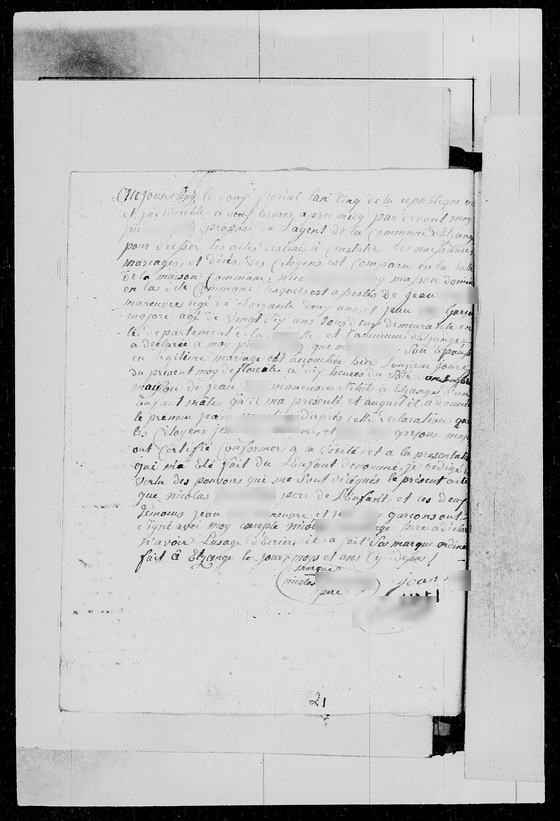
In a Revolutionary record, the date is often not the hardest part: the clerk's rapid hand, surnames, occupations, ages written out in words. KinScribe deciphers your scan and gives you a faithful transcription, a modern French version and an English translation, with uncertain passages shown on the image.
Decipher my record
$3.00 per document — secure payment, no account or subscription required.