KinScribe
Old handwriting, read by artificial intelligence

KinScribeKinScribe

Centuries of handwriting.
Two minutes to read.
Transcribing and translating any old handwritten record or document, in French or German — anywhere in France, French-speaking Belgium and Germany. Particular expertise in Moselle, Luxembourg and the surrounding border region.
See five transcribed documents
$3.00 per document read automatically · no account · no subscription
The demonstration

Example on a real record.

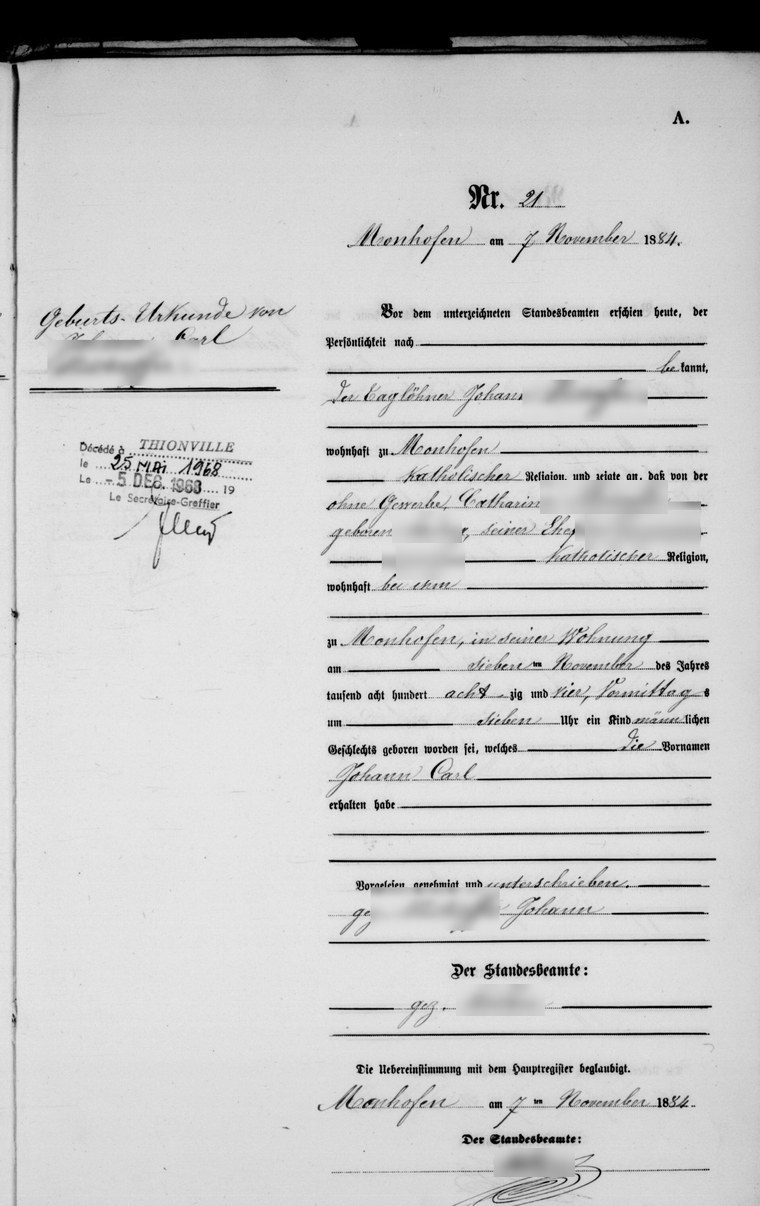
A birth record from 1884, in Kurrentschrift. The scan as it comes from the archives, and what KinScribe makes of it.
W... birth record, 1884 — original scan
The original scan (family names hidden)
KinScribe
Civil records (Standesamt) · Departmental Archives of Moselle, France
Birth record — Manom
Johann Carl (Jean-Charles) W... — 7 November 1884
Call no.9 NUM/446EC3
LanguageGerman (annexed Moselle)
English translation
“Before the undersigned registrar appeared today the day laborer Johann W..., residing in Monhofen, who declared that his wife Catharina, née S..., gave birth on the seventh of November eighteen hundred and eighty-four, at seven o'clock in the morning, to a child of male sex, who was given the first names Johann Carl.”
Transcription assisted by artificial intelligence — KinScribe
Source: Departmental Archives of the Moselle (archives57.com) — Monhofen (Manom), record no. 21 of 7 November 1884.
What you get

Four readings of one record.

I
Faithful transcription
Line by line, period spelling kept, abbreviations expanded, every doubtful word flagged.
II
Modern French
The same record in today's French, punctuated and readable — revolutionary dates converted.
III
English translation
Written for a genealogist who reads neither French nor German, with period terms explained.
IV
Structured data
People, roles, occupations, ages, witnesses — ready to enter into your family tree.
What no one else does

One town, several names depending on the year.

Under the German annexations, the towns of the Moselle were renamed — and not just once. Amanvillers was Amanweiler in 1890 and Almansweiler in 1942. A village name read on a record means nothing until you know which period it belongs to.
Monhofen→Manom
Diedenhofen→Thionville
Saargemünd→Sarreguemines
Amanweiler · Almansweiler→Amanvillers
Close to 890 historical forms from the Moselle and Luxembourg are recognized automatically: the present-day name appears in your result without your having to look it up. And when a form cannot be dated with certainty, it says so plainly instead of passing it off as settled.
The price
$3.00
per document, read automatically, transcribed and translated in one to two minutes. You pay for what you upload, and nothing else.
No subscription.
Nothing renews, nothing needs cancelling. You buy one document at $3.00, or several up front at a discount. You only pay for what you use.

Automatic reading

$3.00 per page · instant
  • Result in one to two minutes, next to your scan.
  • A second, blind reading and consistency checks (dates, ages, numbers written out in words) flag the uncertain passages.
  • You review, correct and approve it yourself before exporting: every field can be edited.

Reviewed by KinScribe

from $9 per page · within 3 business days
  • The automatic reading, then a word-by-word human review against the scan, by a specialist in Moselle records and old German script.
  • Uncertain passages are settled or marked as illegible, never guessed.
  • You receive the already approved version by email.
Request a review →

Codes are valid for one year and also work on the French version of the site.

1. You are taken to a secure payment page 2. You pay once 3. You come back here and your document appears
Card Apple Pay Google Pay PayPal No account to create · No card stored · Your card number never passes through KinScribe
The tool

Your document

Drag and drop an image here, click to browse, or paste (Ctrl+V) a screenshot
PNG or JPG, up to 9.5 MB · one page per image, at full resolution (at least 1,500 pixels high recommended)
Beyond transcription

When the work is to find it, not just read it.

The tool above deciphers the document already in front of you. These services cover the rest: locating a record you do not have, working through a document far too long for a single page, or tracing your ancestry back several generations — with, for that last one, a heritage trip dossier available as an add-on. Every request is scoped in writing before anything is billed.

Locating a record

$19per record

France, Luxembourg, Wallonia and Rhineland-Palatinate. Tell us what you know — a name, a commune, an approximate period — and the record is found, transcribed and translated.

Feasibility within 48 h Result within a week Records over 75–130 years old, depending on country

If the record can't be consulted online (destroyed, never digitized or too recent, see the terms), nothing is billed. Otherwise the search is due even without a result, and the next one is half price.

Delivered the full reference (archive service, call number, view number), the image of the record, its transcription and its translation.
Send a request →

Notarial documents and long deeds

from $9per page

Marriage contracts, probate inventories, wills, estate divisions, sales, leases, debt acknowledgements. These have neither the length nor the structure of a civil record: several pages of dense handwriting, the legal language of the period, vanished units and currencies, inventories of goods running across whole folios.

Delivered every page transcribed in full and then modernized; the old legal terms, the measures (setier, arpent, journal) and the currencies (livre tournois, écu, franc germinal) explained in notes; a table listing the parties, the witnesses and the notary.

A quote is issued beyond five pages. The same rate applies to civil or parish registers spanning several pages (for example a double page, or a record running over two folios): the tool above transcribes one page at a time.

Send a request →

Tracing your ancestry back

$260

An ancestry is traced back generation by generation from a starting point you provide: a record, or simply a name and a commune. Every parent-child link rests on a record actually found — never on an inference, and never on a tree copied from an online database.

Four generations 15 people including you, 14 ancestors$2605 weeks
Beyond four generations, or a single branch of your choiceon quotedepends on workload
Delivered every record as an image with its archive reference, transcription and translation; an ancestry chart; and a note setting out, generation by generation, what is established and where things stand.

The last generation is a goal, not a guaranteed result: when an earlier ancestor's home commune isn't known in advance, finding it can take longer than the package allows for. The search then stops where it stands, with a precise account of what is established and what remains open, rather than running on without a limit on time or price. One more limit worth knowing before ordering: if your starting point is a record less than 75 to 130 years old, depending on the country, that you don't already hold, it isn't online and the ancestry can't be started from there — see the country-by-country detail in the terms.

Add-on — $99
Once your ancestry has been traced, a heritage trip dossier on your family's places of origin can be added — built from the records already found for that request, never offered on its own. Delivered as a PDF booklet laid out like a real book: cover, foreword, table of contents, an overview of the ancestry, one chapter per commune (current addresses, the state of each site, cemeteries, local archive holdings, a realistic itinerary), the historical context and your ancestors' trades, the points to watch before you leave, and an index of the names and places cited. See an example book (fictitious family) →
Background: the cover of a real dossier (family and place changed for this example) — Turgot's map of Paris, 1739.
Send a request →
Launch pricing, to be adjusted after the first feedback. Every service is paid before work starts, like the automated transcription — the request exists first to scope the work and confirm it is feasible.
Frequently asked

What people ask before paying.

What documents can you read?
Civil records, parish registers, notarial deeds, family letters, wartime correspondence, postcards — in old French as well as German script (Kurrentschrift, Sütterlin), from the sixteenth to the twentieth century. Anywhere in France, French-speaking Belgium (Wallonia and Brussels, whose civil registration has followed the same Napoleonic form as the French one since 1796) and Germany — including Belgium's East Cantons, kept in German until 1920. Particular expertise in Moselle, Luxembourg and the surrounding border region. Two reservations: parish registers from the Ancien Régime are often written in Church Latin — they are transcribed and fully translated into English and French, but the reading is then explicitly flagged as less certain and the confidence level lowered accordingly; and records written in Dutch (Flanders) are not covered.
Do I need an account or a subscription?
Neither. You upload your image, you pay $3.00, you get your result. If you buy a pack, you receive a code: keep it and you can come back to use your remaining credits whenever you like.
How long does it take?
Less than two minutes in the vast majority of cases. The result appears directly in your browser; you can also email it to yourself, at the address entered when paying.
Is my document kept?
For as short a time as possible. When you pay per document, your image is held for at most two hours — long enough to complete the payment — and deleted as soon as the transcription is delivered. When you use a credit code, it is never stored at all. Only the resulting text stays available for twenty-four hours, so you can come back to it if you close the tab. The deciphering itself is performed by Claude, Anthropic's artificial intelligence, which deletes the image and text from its servers within thirty days and does not use them to train its models.

On your own device, however, the result and the image remain available for seven days in your browser (nothing is sent back to KinScribe): reloading the page, losing your connection or closing the tab won't lose anything. The "Clear all" button deletes them.

A service request submitted through the form follows a different rule, because it involves an exchange: the request and any attached documents are kept for as long as it takes to handle it, and at most ninety days, then deleted automatically. You can ask for them to be deleted sooner by quoting your reference.
Can I correct the text before saving it?
Yes — the workflow is built around it. The result appears next to your scan in editable fields: you correct whatever you want, in particular the words flagged as uncertain, then you choose which versions to export.
In what formats can I save the result?
Your choice, for each version: image (PNG), PDF, or plain text (.txt) to paste into your genealogy software.
Is the transcription guaranteed to be accurate?
No, and we would rather say so plainly. Artificial intelligence makes deciphering old handwriting enormously easier, but it does not guarantee a perfect reading. Doubtful passages are flagged, and you should check the decisive details — dates, names, parentage — against the original record before treating them as settled.
What if the image is unreadable or the result unusable?
Click "Result unreadable or unusable?" below the transcription: an email already filled in with the document's reference opens. Another attempt or a refund, guaranteed.
Can I withdraw after receiving my transcription?
No — and that is why there is a box to tick before payment. For digital content delivered immediately, the law provides that the fourteen-day right of withdrawal is extinguished once you have requested immediate performance and acknowledged giving up that right, which is exactly what ticking the box confirms. A transcription already on your screen cannot be "given back", and the law takes account of that.

Credit packs follow a more favourable rule: at the time of purchase nothing has been delivered to you yet. Within fourteen days you may therefore ask for a refund of the credits you have not used; only the documents already transcribed remain payable.
How does a service request work?
Nothing is paid when you send the request. You describe what you need in the form, attach your documents if you have any, and receive an eight-character reference. The request is read, and you then receive by email either a quote or — this happens with some searches — an explanation that the record no longer exists or was never digitized. That second answer costs nothing. Payment comes only once you have accepted the quote.
What exactly happens when I click "pay"?
Three steps, no surprises. One: you leave KinScribe for a secure payment page run by our payment provider, Stripe — its address begins with checkout.stripe.com. Two: you pay $3.00, once; your bank may ask you to confirm the payment in its app or by text message. Your card number is entered on Stripe's page: it never passes through KinScribe and we never see it. Three: you are brought straight back here, your transcription appears, and a receipt is emailed to you. No account to create, no subscription, no card stored for later.

A question that is not answered here, or a particular need? Write to us — a reply within 48 hours.